
Configuring GridGain Monitoring Alerts
An alert notifies you when a cluster metric or condition crosses a configured threshold. By configuring alerts, you automate routine monitoring and can respond when important signals require attention. For example, you can be notified when off-heap memory usage grows too high, disk usage approaches a limit, or the number of server nodes drops below the expected count.
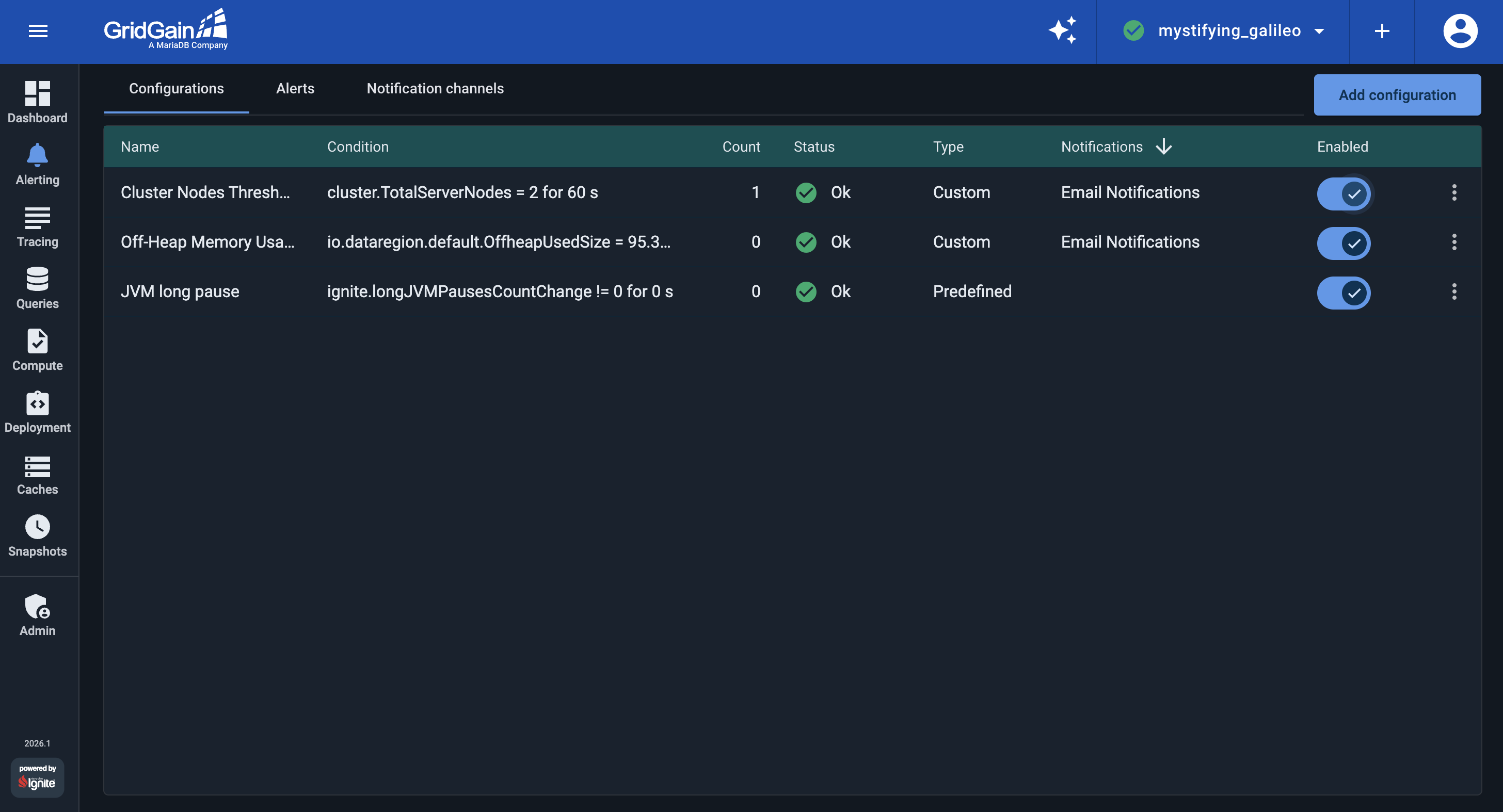
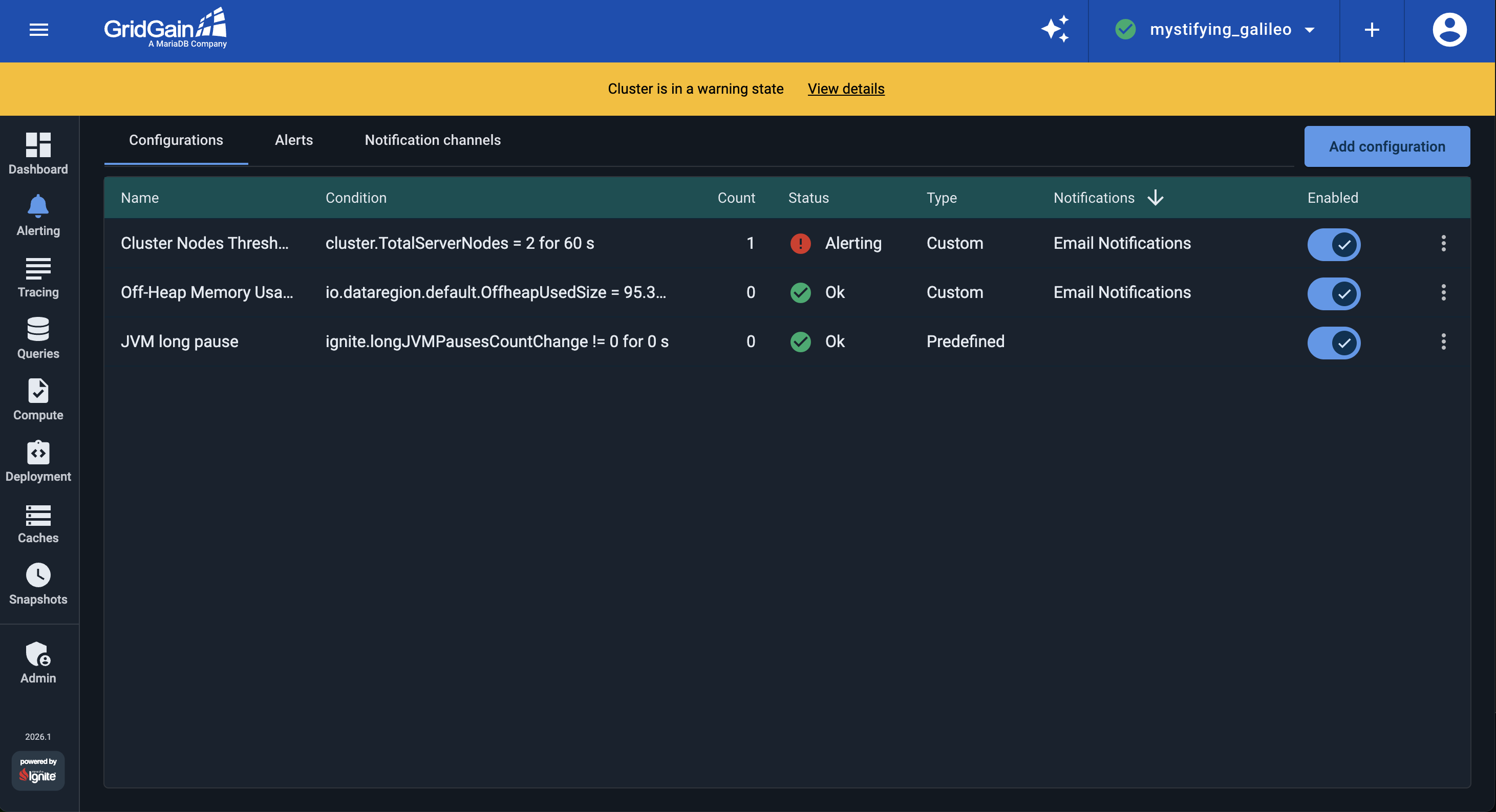
GridGain Control Center provides built-in alerting capabilities for GridGain metrics. In this part of the tutorial, you configure two alerts: one for off-heap memory usage and one for server node count. By the end, your alerting screen should look like the following:
Configure a Notification Channel
To receive notifications when an alert fires, set up at least one notification channel. Control Center supports email, SMS, and webhook channels.
Open the Alerting screen,
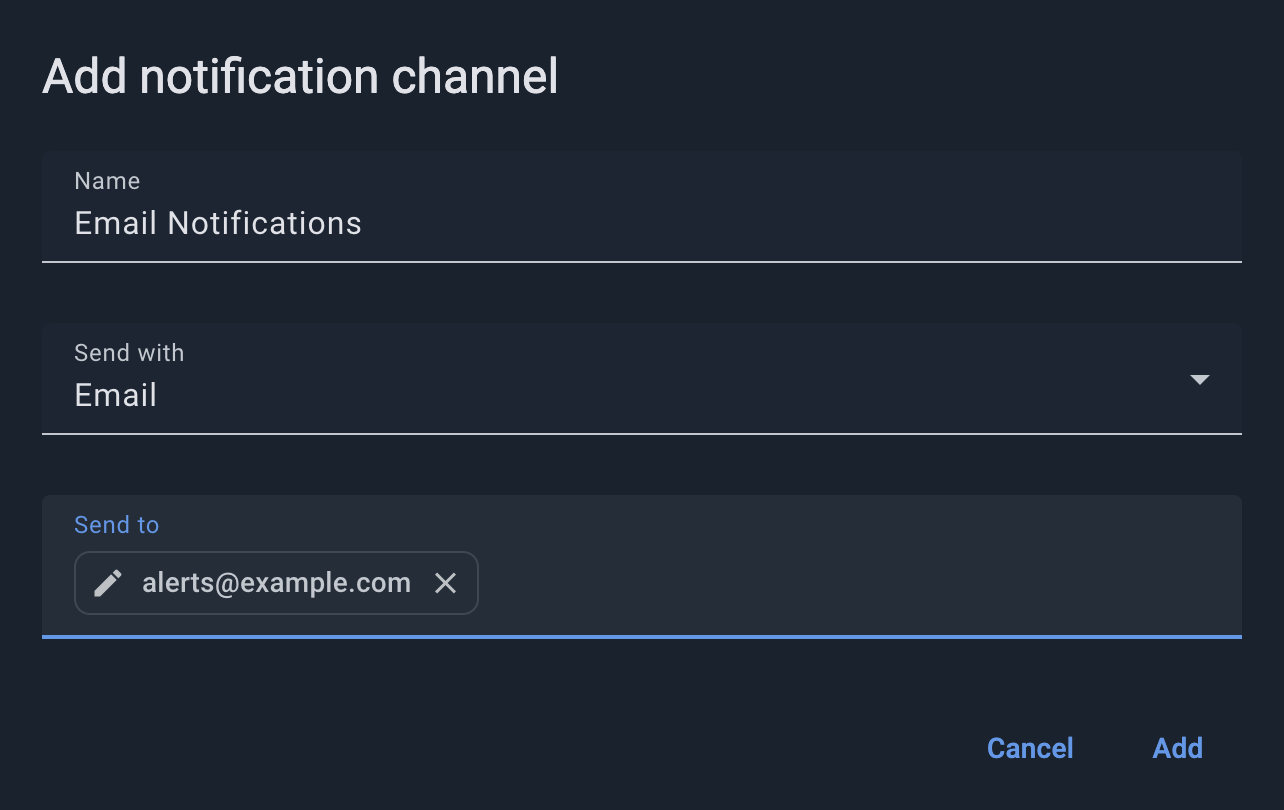
select the Notification channels tab, and click Add notification channel. Fill in the dialog:
-
Name: a name for the channel. For this tutorial, useEmail Notifications. -
Send with: selectEmail. -
Send to: an email address that should receive alerts.
Click Add to save the channel.
Create a Memory-Usage Alert
In the second part of the tutorial, you configured the Storage Usage dashboard, which displays various memory and disk-usage metrics. Now create an alert for off-heap memory usage, one of the core storage-pressure signals from that dashboard.
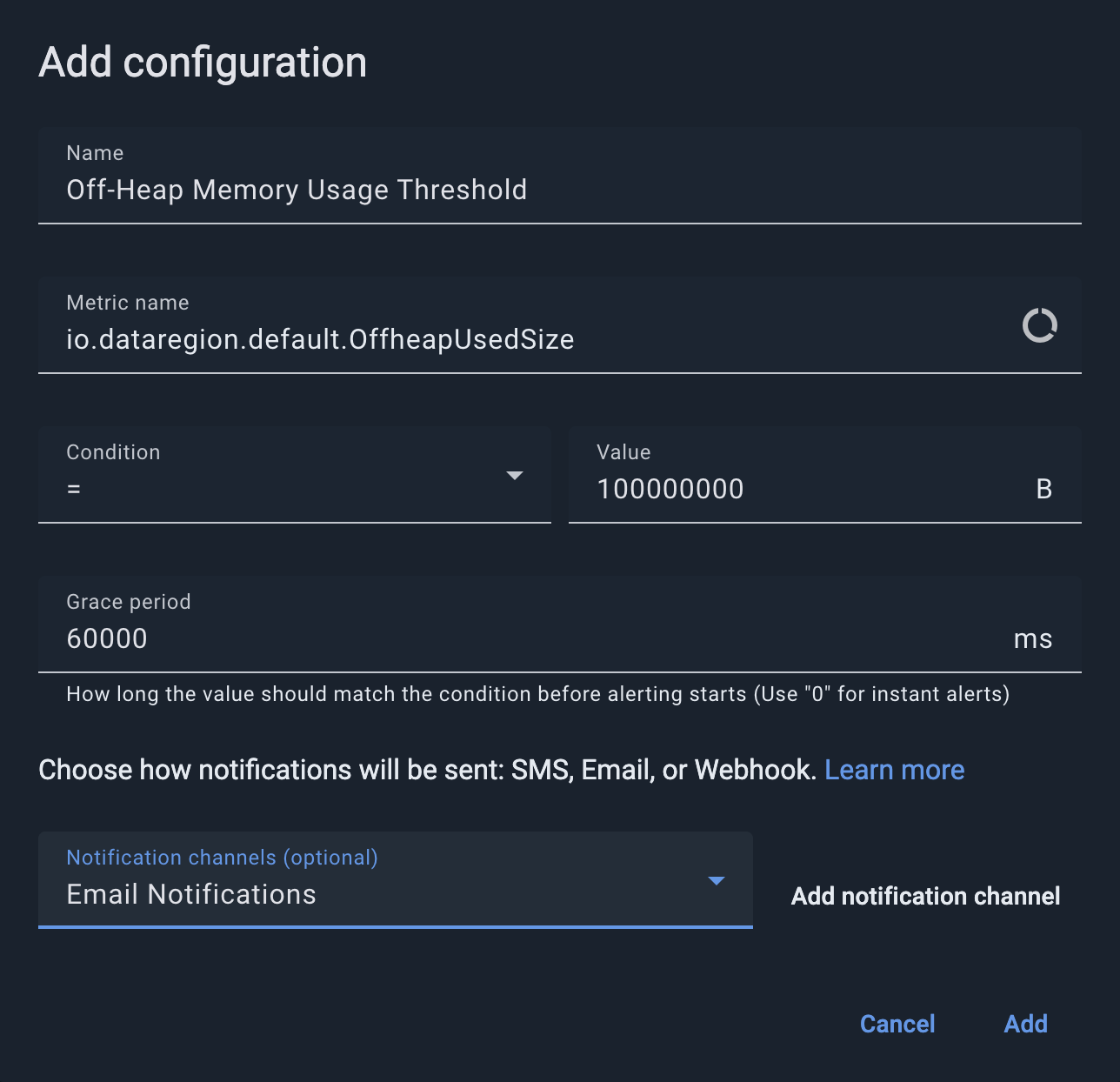
On the Configurations tab, click Add configuration and configure an alert that fires when off-heap memory usage exceeds 10 MB on any node:
-
Name: Specify a custom name for the alert, such asOff-Heap Memory Usage Threshold. -
Metric Name: In the metrics dialog, select theio.dataregion.default.OffheapUsedSizemetric. -
ConditionandValue: Set the condition to trigger the alert when off-heap usage is greater than10000000 bytes(10 MB). -
Grace Period: Set the grace period such that the alert fires only if the condition lasts for10000 ms(10 seconds). -
Notification Channels: Select theEmail Notificationschannel that you configured previously.
Create a Node-Count Alert
The number of server nodes is a critical parameter for GridGain clusters in production: if a cluster runs with too few nodes, its performance or availability can suffer. In Control Center, you can configure a node-count alert that monitors the cluster’s size and notifies you when it drops to a risky level.
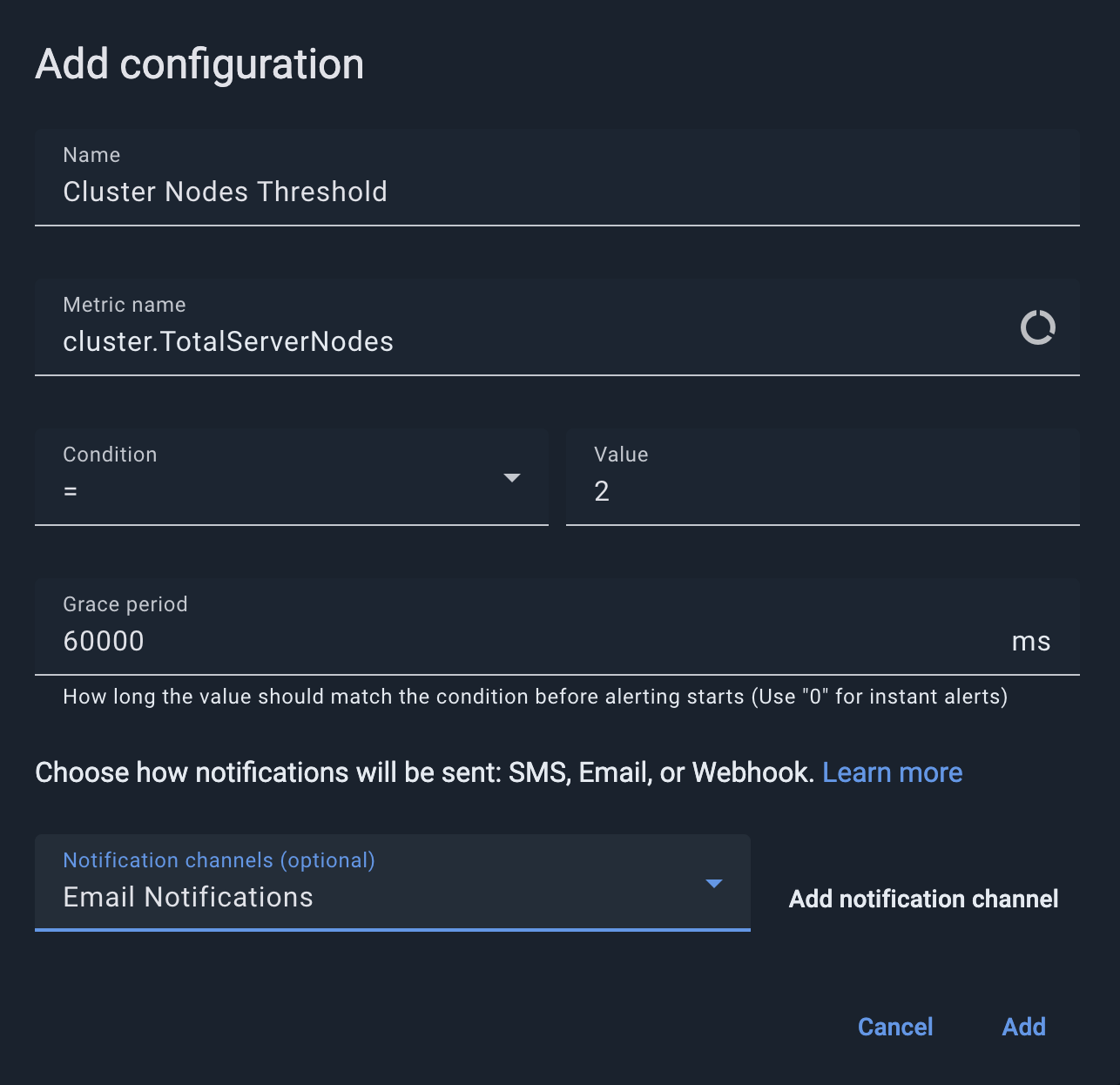
On the Configurations tab, click Add configuration again and configure an alert that fires when the cluster has fewer than two server nodes:
-
Name: UseCluster Nodes Thresholdas the name. -
Metric Name: In the metrics dialog, select thecluster.TotalServerNodesmetric. -
ConditionandValue: Set the condition to trigger the alert when the number of server nodes is less than2. -
Grace Period: Set the grace period to0to ensure that the alert fires without delay. -
Notification Channels: Select theEmail Notificationschannel that you configured previously.
Test the Node-Count Alert
Test the alert by taking one of the two server nodes offline. Stop the second node’s container; cluster.TotalServerNodes
drops to 1 and Control Center raises the alert. If you set up a mail server for the notification channel above, you
also receive an email.
docker stop docker-ignite-server-node-2Before you proceed with the following parts of the tutorial, start the node again:
docker start docker-ignite-server-node-2Review the Final List of Alerts
You now have two alert configurations:
-
Off-Heap Memory Usage Threshold: fires when off-heap memory usage exceeds the configured threshold. -
Cluster Nodes Threshold: fires when the number of server nodes drops below two.
What’s Next
In the next part, you use tracing to investigate performance bottlenecks and hot spots in cluster operations:
© 2026 GridGain Systems, Inc. All Rights Reserved. Privacy Policy | Legal Notices. GridGain® is a registered trademark of GridGain Systems, Inc.
Apache, Apache Ignite, the Apache feather and the Apache Ignite logo are either registered trademarks or trademarks of The Apache Software Foundation.