
MariaDB just completed the acquisition of GridGain. Before I go into why this is a very exciting and promising milestone for GridGain and its customers, I want to provide some important context about what’s happening in the industry.
Technology trends today
AI, AI and more AI
This has arguably been at least as ground-breaking a trend, if not more, as the Internet was a few decades ago. And while some may think it is easily the most societally pivoting technology, it has been built because of the scaffoldings that were put together by the internet. That said, AI has seen the steepest and shortest adoption curve. There isn’t any individual or an enterprise that is not impacted by AI today in some way or the other.
Waiting is expensive
In today’s world, executing something in one second today is 999 milliseconds too long. Consumers are demanding greater performance and speed from their technology every day because anyone who is not building for performance & speed is already two steps behind in the race. This demand is only magnified a thousand-fold in today’s growing agentic economy. More and more tasks are being executed by autonomous agents and enterprises are expecting their technology to deliver on that need.
Data problem on hand
Between hyperscalers, GPUs and QPUs, the availability of powerful enough infrastructure on demand is not a constraint anymore. Data availability and accessibility, on the other hand, is still a challenge. As I explained in more detail on another forum, accessing relevant data, maintaining context and processing it all quickly enough are major hurdles in servicing the market’s need for faster and autonomous decisioning. Data sovereignty and other regulatory constraints only make the problem worse.
Data silos are like tolls
Imagine driving on the Autobahn but having to stop and pay tolls every few miles. That’s exactly how it is with data moving through a siloed enterprise data architecture. Every time data crosses an application boundary, it pays the latency toll.
Optimized point solutions are not enough
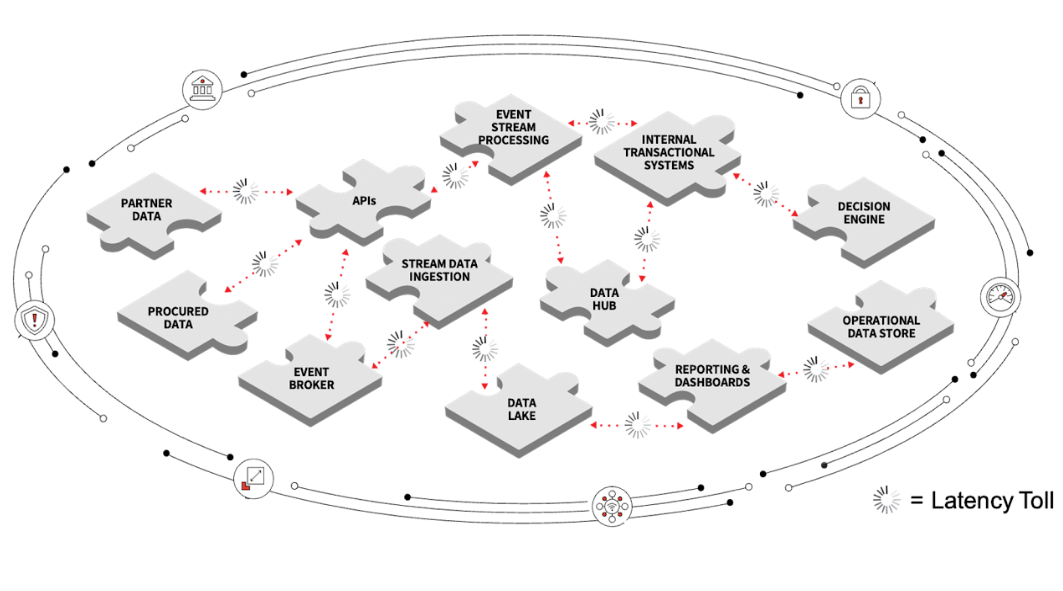
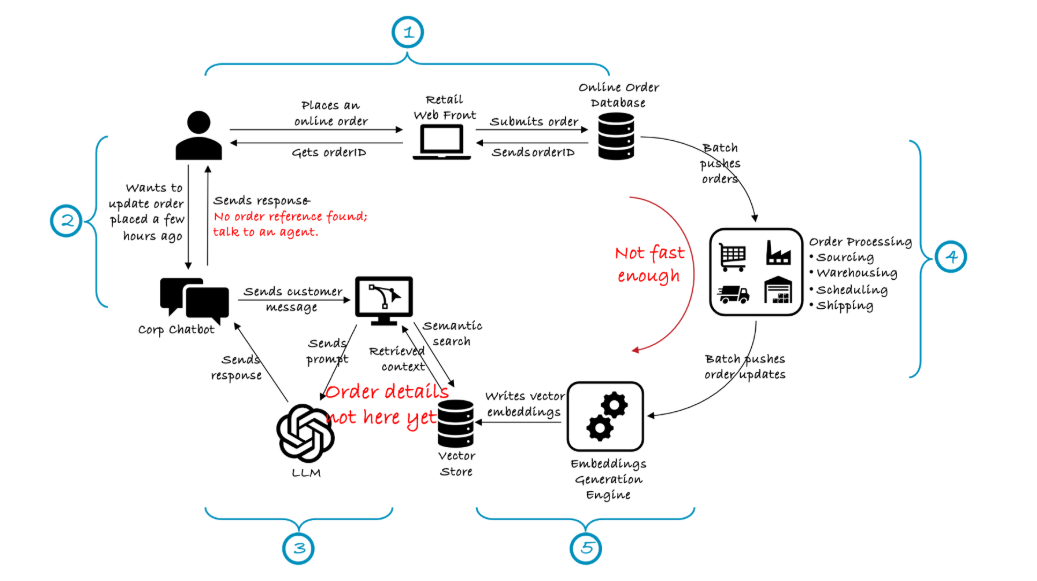
Even if you have optimized each of your applications individually, the overall data ecosystem is still slow because of the latency toll. And if this sounds familiar, this is exactly what you see with a portfolio of applications you get from your favorite hyperscaler. Let’s look at an example of a real-time RAG application. Having a stand-alone high performance vector embeddings generation engine or a fast vector store are not enough. If the event making its way through the enterprise data ecosystem does not get to the vector store quickly enough, the RAG application will not be able to provide an appropriate prompt to the LLM generating results for queries around that event. The picture below illustrates what I’m talking about.
MariaDB and GridGain
Enterprises today are looking for tighter vertical integration, while also ideally limiting their exposure to bespoken technologies. They want to:
- Not have to assemble a bunch of Lego blocks;
- Minimize the number of hops between their transactional, analytical, and decisioning systems;
- Have the option to grow or reduce vendor dependency; and
- Not compromise on the reliability, durability, and security that customers expect.
This is exactly what MariaDB and GridGain have come together to deliver.
Technological synergies
The combination of an industry leading distributed, in-memory computing platform and a world class relational database gives enterprises a unified solution that not only provides them with the durability, data security, and data integrity, but also the power of distributed computing and horizontal scale for all types of transactional, analytical, and agentic workloads.
GridGain’s proven distributed, in-memory computing platform strengthens its reliability and durability, while MariaDB’s widely deployed database improves its ability to be distributed and scale across data centers, regions and hyperscalers. Add to this MariaDB Exa’s industry leading analytical capabilities, GridGain’s powerful HTAP architecture and a combined, on-disk and distributed, in-memory solution and you have a foundational platform for processing complex AI workloads and agentic applications.
Cultural fit
I have led almost the entire GridGain team over my various roles in the company and have come to know a lot of our people very closely. I also had the luxury of working closely with the MariaDB team since we started initial discussions around this transaction. And I find myself to be uniquely qualified to state that, above and beyond the technological synergies, this acquisition brings a lot of very passionate and smart people together, all of whom are aligned around a shared vision, common goals and what we want to achieve. It is this singular focus on delivering solutions that give our customers a clear technology-driven competitive advantage. These people are fully supported by an executive team that believes in hard work and having a lot of fun while doing so.
Open source based DNA
Finally, the most important alignment I see between the two companies is our commitment to open source - both companies have community and open core in their DNA. This foundation of open source upon which MariaDB and GridGain (the original creator of Apache Ignite) have been built should give our commercial customers the comfort that they are not locked-in, that they have a choice and that they come to us for the added value we provide. That value may come in the form of additional features or simply the comfort that the software they rely on comes with a level of quality, rigor, and reliability required for mission-critical enterprise use-cases.
Conclusion
I had predicted a couple of years ago that we will see the rise of a modern data architecture to address the multi-dimensional nature of the enterprise data problem that will manifest itself is through consolidation of technologies, a focus on vertical integration within the data architecture, and a flurry of M&A activity in the data management technologies space. This is exactly what we saw with the likes of Databricks, Snowflake and IBM in the last 12-18 months and the acquisitions they made. GridGain and MariaDB now offer enterprises an extremely viable foundational platform for a high-performance and durable data architecture, without the downside of the pressures they face from the big vendors. And there is still a lot more to the MariaDB story. We will continue to build out scalable, durable and ultra-low latency data architecture to address the next set of challenges our customers will face as they implement agentic applications within their enterprises.